
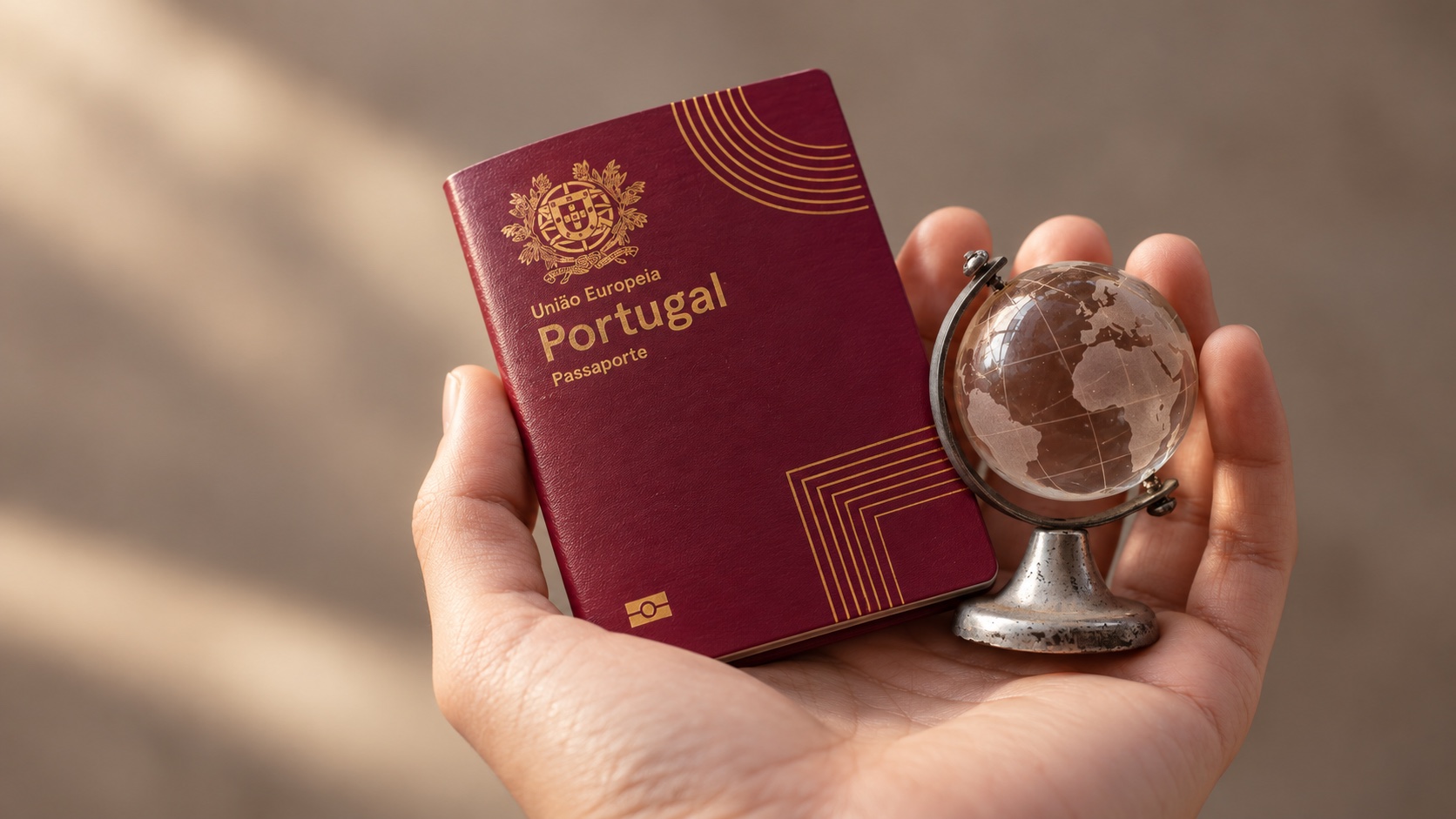



Portuguese citizenship — and the privileges of being a European citizen.
A passport among the most respected in the world, the freedom to live, study and work in any European Union country — and a right that passes on to your children. If you have a connection to Portugal, the first step is knowing exactly where you fit.
Find out if you qualify
It takes one minute. Your written assessment arrives by e-mail.
- Free assessment, no commitment, no paid consultation
- A written answer from a lawyer registered with the Portuguese Bar — not a call-center agent
- Transparent service pricing: no surprise charges later
- No barriers, no middlemen: you deal directly with the firm
Free and with no commitment. No paid consultation.
- —Those who have legally lived in Portugal for over 7 years (10 if not from a Portuguese-speaking or EU country)
- —Children of Portuguese citizens
- —Grandchildren of Portuguese citizens
- —Great-grandchildren, step by step, through certain paths
- —Spouses and partners of Portuguese citizens for at least 3 years
- —Parents of a child born in Portugal (with 5 years of legal residence by a parent)
- —Other cases set out in the Nationality Law
The law changed in 2026 and requirements became stricter. The right legal framing makes all the difference — and that is exactly what the free assessment verifies.
- Live, study and work in any European Union country
- One of the strongest passports in the world, with easy entry to dozens of countries
- Access to public healthcare and education in Portugal and across the EU
- A right you pass on to your children
- Move and reside across Europe without visas or day-counting
- A financial life in Europe without foreigner restrictions
Registries, apostilles, certificates, translations, official requests: a nationality process is made of paperwork and deadlines. Our job is to carry that weight for you — we organise, check and file, and you follow everything in writing, from wherever you are.
Your case is assessed and handled by a lawyer licensed in both countries — Dra. Dourado, professional licence 62399L (Portuguese Bar Association) and OAB/BA 61237 (Brazil), verifiable in the official records of both bars.
The window will not stay open forever
The Nationality Law hardened in 2026: longer residence periods and stricter rules — and further changes remain under debate. Qualifying under today’s law is no guarantee the same doors will be open tomorrow. If your case fits the current law, the time to document it is now.
Find out if you qualifyComplete case analysis
We verify how you fit under the law in force and reply in writing with the path and what will be needed.
Complete document preparation
Certificates, apostilles, translations: we tell you what is missing, check what arrives and assemble the file.
Support at every stage
From the first document to filing — up to the IRN protocol number, the proof your application is in.
Experience in both countries
A lawyer licensed in Portugal and Brazil, with practice in both legal systems.
100% digital efficiency
No travel, no queues, no lost paperwork: everything in writing, fully remote.
Personalisation
Every case has its own legal framing — there is no one-size-fits-all here.
Security and transparency
You know what you hired, what it costs and where the service ends. No fine print.
Portugal keeps its own civil registry. A divorce decree issued by a court outside Portugal does not change the Portuguese record on its own: until it is registered here, the record still shows the earlier marriage. Registering it is a step of its own, and it comes before the citizenship filing.
How registering a foreign divorce works →
It came from China. It became the name of Portugal.
Portuguese ships carried it west — and across half the world the word for “orange” is still a form of “Portugal”: portakal, burtuqal, portokali. It crossed, it stayed, and no one asks where it came from anymore.
That is what recognition is: what crossed over comes to hold here — without ceasing to be what it was.
The Nationality Law provides several routes: children and grandchildren of Portuguese citizens, spouses and recognised partners, among other connections. Each route has its own documentation requirements. The form exists so we can tell you which one is yours and whether it can be started.
No. The application we handle is filed directly with the IRN (the Portuguese civil registry), with no court involved. If any step of your case requires a different path, we tell you in writing before you hire anything.
No, and be wary of anyone who promises that. The decision time belongs to the IRN, and the law forbids lawyers from promising timelines. What depends on the firm moves without dead stages: the right documents at the first filing and a recorded follow-up.
Not for what we do. The process is documentary and handled in writing. You gather your documents in your country with our guidance and we handle the filing.
It can. If your marital status changed outside Portugal, the Portuguese record needs to be updated first, often through recognition of the foreign judgment. We assess both together.
The fee is flat per service type and arrives with the assessment of your case, in writing, before any commitment.